
Advancing inclusive food security through interdisciplinarity and collaboration
According to a recent United Nations report, over 600 million people worldwide faced undernourishment or chronic hunger in 2024. Whilst global indicators have gradually declined since 2021, they remain higher than those recorded prior to the COVID-19 pandemic. This exposes the vulnerability of existing food systems anchored on the corporate-dominated world market, noting how global supply chain disruptions have deepened food insecurity across regions.
The problem has been exacerbated by the detrimental impacts of climate change on an already fragile agriculture sector, especially given the environmental degradation and, consequently, farmland productivity decline brought about by years of industrial practices to support export-oriented production and import-dependent consumption. In exploring ways to address this food poly-crisis, I came across the concept of food sovereignty during my Global Development MA at the University of Leeds in 2019. Championed by peasant-led social movements, food sovereignty defends the right of communities to control their own food systems. Instead of big businesses and global trade, it values the ability and indigenous knowledge of smallholder farmers to secure the right to food for all through ecologically sound and culturally appropriate production and localised fair markets.
But whilst food sovereignty offers a powerful framework for a just and equitable food system, it is also fraught with tensions. My current PhD project, affiliated with the Centre for Global Development of the University of Leeds – School of Politics and International Studies, particularly examines how the decreasing number of smallholder farmers can practicably meet the dietary requirements of a growing number of non-food producing consumers, especially the poor who may not be able to afford ‘fair’ prices. In other words, I sympathise with what food sovereignty is fighting against but question how it can ensure inclusivity in realising its radical agenda for food system transformation. Achieving inclusive food security ultimately requires addressing the competing interests of stakeholders, shifting our attention to what we ought to be fighting for and, more importantly, for whom.
My research frames food security, not merely as a technical problem, but as a sociopolitical issue. I have observed how food (in)security discussions within and outside academia tend to be dominated by technology-driven solutions, often sidelining the equally important need to address social inequalities and political conflicts within food systems alongside agricultural productivity enhancement and food science advancement. Despite this gap, there seems to be a scarcity of postgraduate researchers (PGR) tackling food as a primary research topic within the University of Leeds – Faculty of Social Sciences.
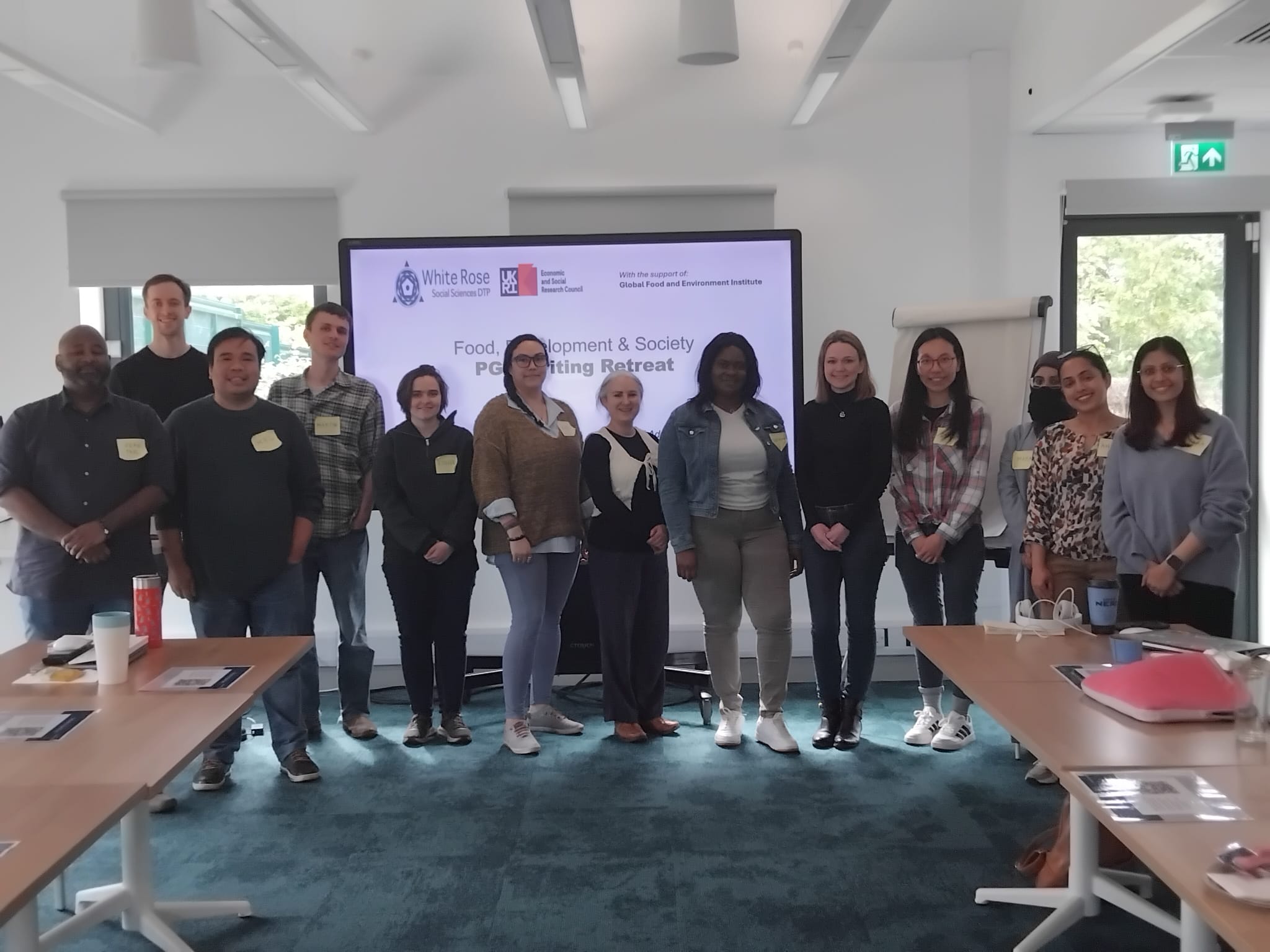
For example, I recall being the sole PhD project featured in the Faculty’s World Food Day news article last year. Fortunately, the Global Food and Environment Institute (GFEI) and the White Rose Doctoral Training Partnership (WRDTP), through the Civil Society, Development and Democracy Pathway, have supported me and two other colleagues in organising a writing retreat last May 2025 to gather PGRs from across Yorkshire with shared interest in the social science of food.
Aside from working on our individual writing projects, the retreat has also allowed participants to learn about each other’s work and explore potential collaborations. In the end, we have agreed to establish a research network under the broad theme of “Food, Development and Society” (FDS) to support PGRs and Early Career Researchers (ECRs) in promoting interdisciplinary food research.
My recent GFEI and WRDTP-funded initiative positively contributed to my professional growth in at least two ways. First, it marked my first successful grant in UK academia outside my PhD project. The engagement required me to write a proposal, collaborate with co-organisers, coordinate logistics and finance, and become a writing workshop facilitator for the first time. These transferable skills that were further developed in the process would be helpful for my career prospects in the future. Second, it became a platform for building a community of individuals who are working within my broader research field and can likewise relate to my current challenges as a junior academic. This could aid me, not only in acquiring interdisciplinary insights for my research, but also in accessing peer support.
Moving forward, I and four other co-conveners from the University of Leeds, University of York, and University of Sheffield will be actively contributing to building and scaling the FDS PGR/ECR Network. We already have 60 registered members since our official launch last July 2025, and our community continues to grow. Our planned activities for Academic Year 2025-2026 include food research webinars, peer-to-peer research presentation/feedback sessions, another writing retreat, and a PGR/ECR conference and ‘hangout’. More importantly, we intend to continue working with institutions such as the GFEI to ensure that the directions of the Network align with bigger research aims and impact targets. After all, promoting inclusivity in food security demands that no individual or discipline be left behind—and that collaboration becomes our shared imperative.
Written by Mel Yan, PhD Researcher at the School of Politics and International Studies, University of Leeds.